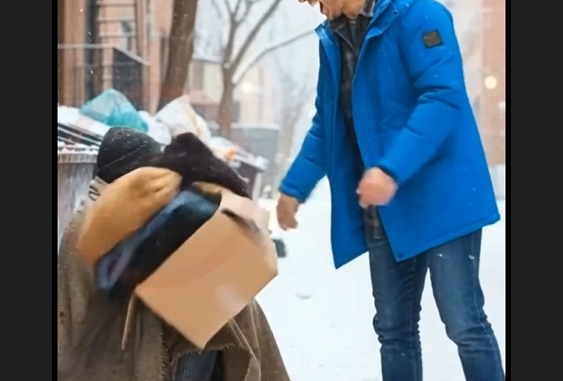
The winter air was sharp and unforgiving. Snow lined the streets, and the cold cut through everything. Near a row of trash baskets, a poor man sat quietly, wrapped in thin, worn clothing, trying to protect himself from the freezing wind.
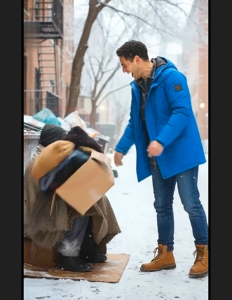
He wasn’t asking for much.
Just warmth.
Just survival.
A young man approached. Without slowing down, without looking into the poor man’s eyes, he tossed a bag of clothes toward him. The gesture was not kind—it was careless, almost mocking. The clothes landed at the man’s feet.
The young man walked away.
The poor man reached for the clothes, grateful for the warmth they might bring. As he lifted them, something fell to the ground.
A set of car keys.
He froze.
For a moment, he simply stared at them. He could have kept them. No one was watching. The young man was already far away. Those keys could have changed everything for him—warmth, money, a way out of the cold.
But he didn’t hesitate.
He stood up, holding the clothes in one hand and the keys in the other, and began to walk. His steps were slow, but his decision was firm. He followed the young man down the street, calling out until he finally caught his attention.
Breathing heavily, the poor man held out the keys.
“These are yours,” he said.
The young man stopped. He looked at the keys, then at the man standing in front of him—cold, tired, but dignified. In that moment, something shifted. The laughter faded. The arrogance disappeared.
The poor man had nothing.
Yet he gave back everything.
That day, no lecture was spoken. No argument was needed. One quiet act of honesty delivered a lesson stronger than any words.
Because dignity does not depend on wealth—and true humanity reveals itself when no one is watching.